Answers only from your products and store rules. Product card and price come from the catalog, not “from the neural network”.
Search, cart and an AI advisor on one screen — just like a real storefront
what is the difference between iPad Pro and iPhone 17 Pro Max?
what processors do your iPads run on?
what is your delivery like?
Loading search…
Cards have “Add to cart”. The “Ask the smart assistant” button opens the chat in the bottom-right corner with the same catalog. Fullscreen demo — button above.
Results come only from your catalog: by meaning, with price and stock. Not the “empty results” of a standard search.
Searches the way people actually type. Click an example — the live demo above will run the query.
| Shopper types | Search finds | |
|---|---|---|
iPhone 17 Pro Max |
as written in Latin script | |
MacBook Pro 16 |
as spoken out loud / transliteration | |
Apple Watch Ultra 3 |
short everyday query | |
iPad Pro 13 M5 |
by spec, not just by name |
Honestly: typos, “wrong keyboard layout” and cross-language are the product goal, not a “99.7% already” promise on this preview. The proof is the live demo above.
No promises: we show the screens the store owner controls.
A store's short path: from assortment to going live — only after your review.
Want this for your catalog? Live demo above, pilot on request.
The catalog the assistant takes price and specs from, and the panel where you decide when it goes live to buyers. Example — Apple / iStore store; you will have your own assortment.
Three screens without which the assistant can't honestly answer shoppers.
Here the owner sees all store products: photo, name, brand, category and publication status. Green “published” means this product can already appear in the assistant's answers on the site. Not published — shoppers won't see it.
Open one item and see the name, description, link to the product page and specs. On the right, a preview of how the buyer will see the card — photo, price, “in stock”. No guessing “what the neural network will draw”.
Further down the card — an image gallery. The first photo becomes the cover of the product card in chat: the buyer sees the same product you uploaded, not a random picture. You can add a URL, a caption and more shots.
Other screens: readiness, import, conversations, leads, rules, gaps, team and settings. Each slide shows what the owner sees and why it matters.
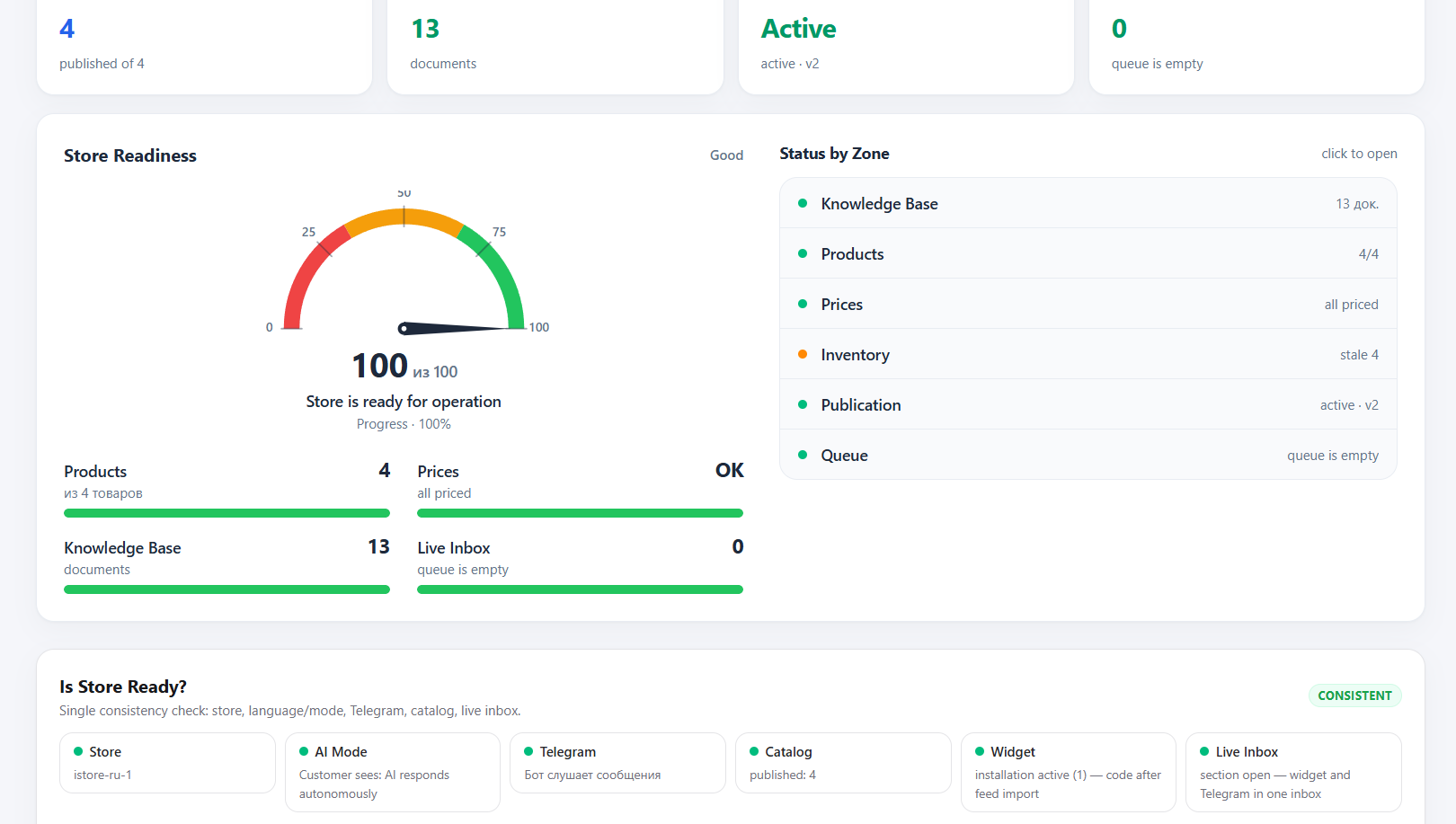
The panel's main screen shows the whole picture: how many products and prices are already in the system, whether store-rule documents exist, whether connections are alive and what the ticket queue looks like. The readiness score shows what still blocks launching the assistant on the site — you decide when to switch it on, instead of “hoping the developer did everything”.
A live feed of site conversations: chats and unread messages on the left, the thread in the center, the product card on the right if the assistant showed it. If a buyer asks for a discount or a tricky case — the manager clicks “take over” and continues themselves. You see what the assistant answered instead of a “black box”.
In the conversation the assistant attaches a card from the catalog: photo, price, stock. The buyer replies based on that card, and when the dialog is handed over, the manager sees the full context — which product was discussed and what was promised.
The same screens as in the screenshots above, on iStore demo data. No registration: the login page has a “Demo Access” button (Google gives you the full panel view). Everything you change is only the demo stand.
The catalog connects with a file or a feed link — without a developer. Chat and search embed into any site with one script tag.
Capabilities come from the catalog and control, not “neural magic”.
What we don't promise: a guaranteed conversion rate, fully autonomous returns and discounts, and order status for any order without connecting your store data.
A system for online stores where buyers choose not “from three buttons” but by specs, compatibility and store rules. A FAQ bot is not enough here: you need an assistant on your catalog and a panel that won't let it go live blindly.
Not our focus: a simple FAQ of “opening hours / where's the parking”, lawyers, clinics, real estate, and the promise of “AI for any business” without a product catalog. Different risks, a different product.
| Regular FAQ bot | “LLM on a feed” | OpsBalance | |
|---|---|---|---|
| Source of facts | Generic templates | The neural network makes it up | Only your catalog |
| Price and stock | May be outdated | May hallucinate | Live from the catalog |
| Pre-launch review | No | No | Check questions + modes |
| “Off” switch | — | — | One click |
| Operator inbox | — | Partially | 3-column, handoff with context |
One script tag: chat and search work on any platform — a custom site, Shopify, OpenCart, PrestaShop. No need to rewrite the storefront.
From your feed: YML/XML, Google Merchant (XML/TSV/CSV), Meta CSV, Shopify CSV — or from the control panel. Prices and stock update from the catalog without retraining.
It honestly says there's no data and hands the conversation to an operator with the full history. It doesn't improvise or invent specs.
Yes: check questions in the panel and the “live / review / off” modes. The assistant goes live only after your review — without a developer.
In the buyer's language: RU, EN, DE, UK are tested on the demo catalog. One knowledge base, in your language.
Yes, a live inbox: the operator takes over the conversation with one button — the AI stays silent while the operator replies. Returning the conversation to the AI is also one button.
Facts only from your catalog, review before going live and an “off” button — see the “Honest comparison by solution type” section above on this page.
A pilot without a price list on the page: tell us about your store and assortment — write to us and we'll discuss your catalog.
Tell us about your store and assortment. In the pilot we review: answers on your cards, panel readiness and the “review / off” modes. No obligations and no pricing on this page.